
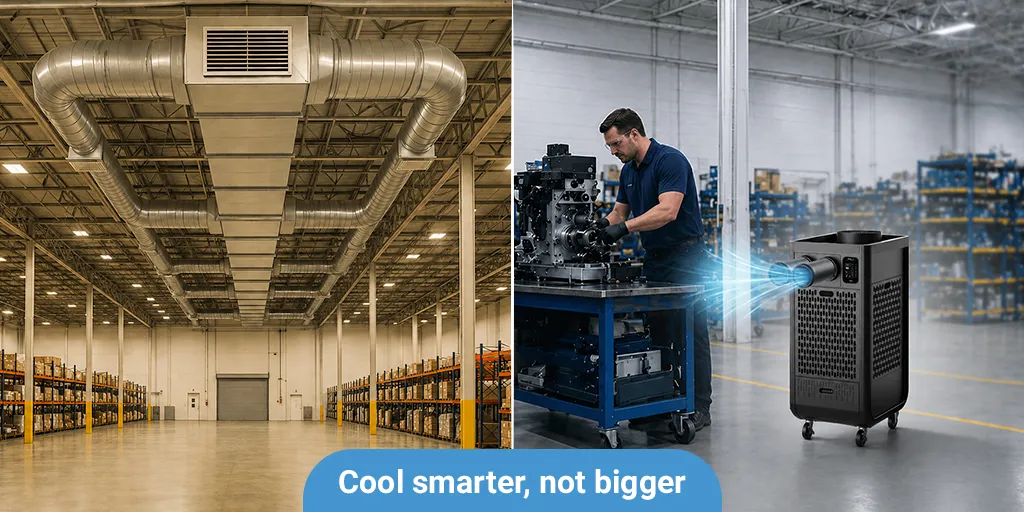
Cooling requirements are rarely static. Many commercial and industrial facilities experience changing conditions driven by seasonal demand, production cycles, equipment upgrades, or unexpected heat issues. As a result, budgeting for cooling often involves deciding between temporary solutions and long-term investments.
Understanding the difference between temporary and long-term cooling needs and how portable air conditioning fits into both can help businesses manage costs, maintain flexibility, and avoid unnecessary capital expenditure.
Understanding Temporary Cooling Needs
Temporary cooling is typically required when heat challenges are short-term, unpredictable, or localized. These situations may include:
- Seasonal temperature spikes
- Short-term increases in production or occupancy
- Equipment overheating during peak loads
- HVAC maintenance, upgrades, or unexpected failures
- Temporary workspaces or facility renovations
In these scenarios, investing in permanent HVAC capacity may not be practical or cost-effective. Businesses need a solution that can be deployed quickly and removed or redeployed once conditions normalize.
Portable air conditioners provide an efficient way to address these needs without committing to permanent infrastructure.
When Cooling Becomes a Long-Term Requirement
Some environments require consistent cooling over extended periods due to ongoing operational demands. Examples include:
- Areas with continuous equipment heat generation
- Facilities with uneven cooling distribution
- Expanding operations where cooling needs evolve over time
- Spaces where centralized HVAC cannot reach specific hot spots
Even in long-term scenarios, flexibility remains important. Cooling requirements can change as equipment layouts shift or operations scale, making adaptable solutions more practical than fixed systems.
Comparing Budget Considerations: Temporary vs. Long-Term Cooling
From a budgeting perspective, the key differences between temporary and long-term cooling include:
- Upfront investment: Permanent systems often require higher capital expenditure, while portable cooling allows for incremental spending.
- Flexibility: Portable solutions can be relocated or repurposed as needs change.
- Deployment speed: Temporary cooling can be implemented quickly without construction or system modifications.
- Scalability: Cooling capacity can be added gradually rather than all at once.
By factoring in these considerations, businesses can better align cooling strategies with financial planning.
How Portable Cooling Supports Smarter Budgeting
Portable air conditioners help organizations bridge the gap between temporary and long-term cooling needs. Instead of committing to fixed capacity early, businesses can use portable units to:
- Address immediate heat issues
- Support operations during peak demand
- Test cooling requirements before making permanent investments
- Supplement existing HVAC systems as needs grow
This approach reduces financial risk while maintaining operational stability.
MovinCool Solutions for Flexible Cooling Strategies
MovinCool’s Climate Pro K Series and Climate Pro X Series are designed to support both temporary and long-term cooling applications across commercial and industrial environments.
These systems allow businesses to:
- Deploy cooling where it is needed most
- Adjust placement as layouts or processes change
- Use units seasonally or year-round
- Support cooling needs without major HVAC upgrades
Because the units are portable and purpose-built, they can adapt as operational demands evolve, making them suitable for both short-term challenges and ongoing use.
Planning for Change Without Overcommitting
Cooling needs often change faster than building systems can adapt. By incorporating portable cooling into budgeting decisions, businesses gain the ability to respond to new requirements without overinvesting in permanent infrastructure.
This flexibility supports better financial planning, improved uptime, and more efficient use of resources over time.
Building a Balanced Cooling Budget
Budgeting for cooling is not an either-or decision between temporary and permanent solutions. Many organizations benefit from a balanced approach that combines existing HVAC systems with portable cooling to handle variability.
By planning for both temporary and long-term needs, and leveraging flexible solutions like MovinCool portable air conditioners, businesses can maintain comfort, protect equipment, and manage costs more effectively.