
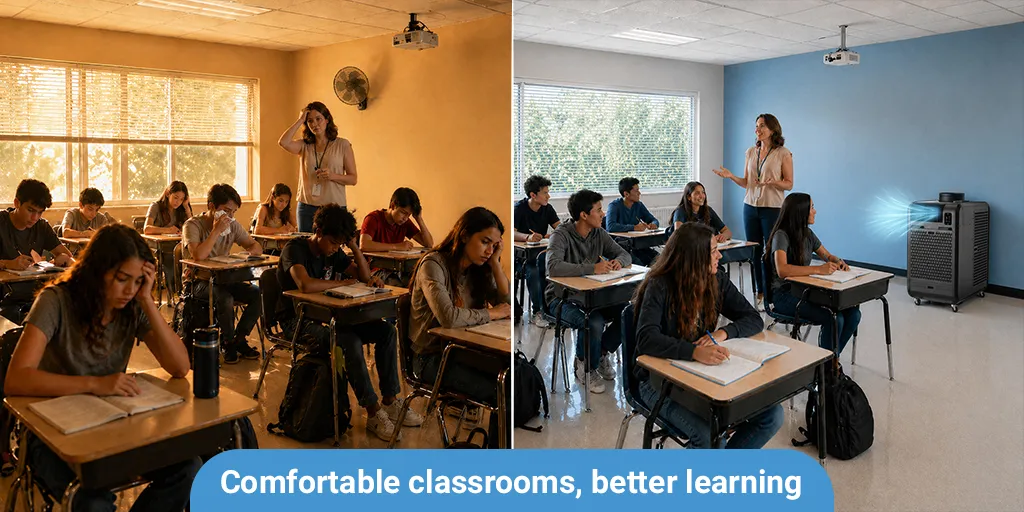
Maintaining comfortable learning environments is a growing challenge for schools and educational facilities. Rising temperatures, aging infrastructure, and changing classroom usage often make consistent cooling difficult, especially during warmer months or peak occupancy periods.
Unlike commercial offices, schools typically operate on tight budgets and fixed building designs, leaving little room for major HVAC upgrades. Portable cooling offers a flexible way to address these challenges while keeping students, teachers, and equipment comfortable.
Why Cooling Is a Common Challenge in Educational Spaces
Many schools were built before modern cooling requirements were standard. As a result, temperature issues often arise due to:
- Older HVAC systems with limited capacity
- Classrooms that overheat due to occupancy, lighting, or equipment
- Uneven cooling across buildings or floors
- Temporary spaces such as modular classrooms or renovated rooms
- Seasonal heat waves that exceed normal operating conditions
When classrooms become too warm, comfort, focus, and productivity can suffer.
The Impact of Heat on Learning Environments
Excessive heat affects more than just comfort. In educational settings, it can lead to:
- Reduced student concentration and engagement
- Teacher discomfort during long instructional hours
- Increased strain on electronics such as computers and AV equipment
- Disruptions to classes, exams, or special programs
Because schools operate on structured schedules, even short-term cooling issues can have outsized effects.
Why Portable Cooling Makes Sense for Schools
Portable air conditioners offer schools a way to respond quickly to heat issues without committing to permanent construction or system changes. They can be used to:
- Cool specific classrooms or learning areas
- Provide temporary relief during heat waves
- Support rooms with higher equipment or occupancy loads
- Supplement existing HVAC systems during peak demand
This targeted approach allows facilities teams to focus cooling where it is needed most.
Common Use Cases in Educational Facilities
Portable cooling is especially useful in:
- Classrooms and lecture halls with high student density
- Computer labs and media rooms generating additional heat
- Temporary or modular classrooms without dedicated HVAC
- Libraries and testing areas requiring stable comfort conditions
- Administrative offices impacted by uneven cooling distribution
Because portable units can be moved, schools can adapt cooling placement as needs change throughout the year.
MovinCool Solutions for Educational Settings
MovinCool’s Climate Pro K Series and Climate Pro X Series provide flexible cooling options suitable for a wide range of educational environments.
These portable systems allow schools to:
- Deploy cooling without permanent installation
- Relocate units between classrooms or buildings
- Use cooling seasonally or year-round
- Address localized heat issues efficiently
Their adaptability makes them a practical option for facilities that need reliable cooling without extensive infrastructure upgrades.
A Practical Approach to Campus-Wide Comfort
Rather than overhauling entire HVAC systems, many schools benefit from combining existing infrastructure with portable cooling. This approach helps manage budgets while improving comfort in high-priority areas.
Portable cooling supports a more responsive facilities strategy, one that adapts to changing classroom usage, seasonal conditions, and evolving educational needs.
Supporting Better Learning Conditions
Comfortable classrooms play an important role in effective education. While temperature challenges are often unavoidable, their impact can be minimized with flexible cooling solutions.
By using portable air conditioners such as MovinCool’s Climate Pro K and X Series, educational facilities can improve comfort, protect equipment, and maintain productive learning environments throughout the school year.