
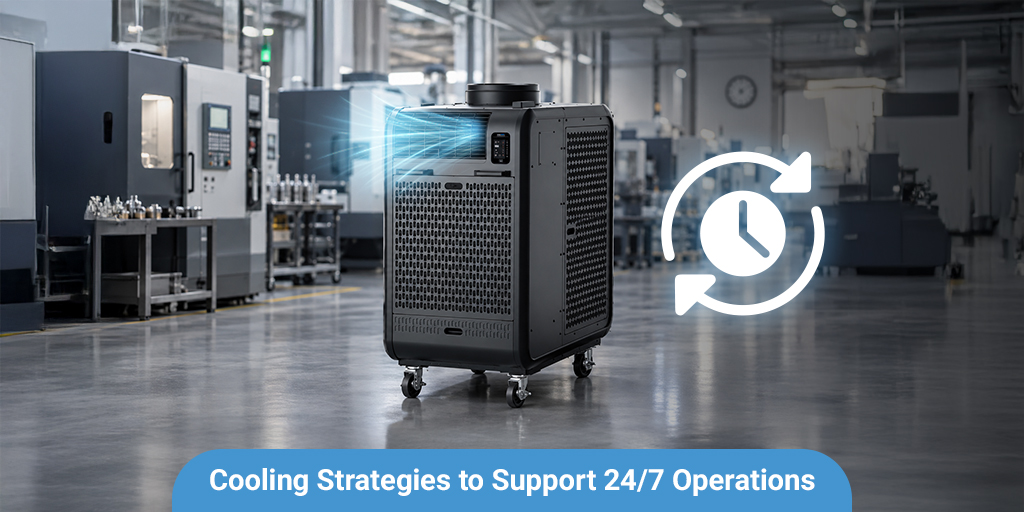
Many commercial and industrial facilities operate around the clock to meet production schedules, customer demand, and operational requirements. For these facilities, maintaining suitable temperatures is not only a matter of comfort. Excessive heat can affect employees, equipment, work areas, and the ability to maintain consistent operations.
A cooling strategy for 24/7 operations needs to account for changing heat loads, equipment that operates continuously, maintenance requirements, and unexpected cooling demands. Portable cooling solutions can provide supplemental cooling where and when it is needed, helping facilities manage localized heat without relying entirely on their primary HVAC system.
Why Cooling Matters for 24/7 Operations
Facilities operating continuously may have different cooling requirements than businesses with standard operating hours. Equipment, machinery, computers, lighting, and other heat-producing sources can continue generating heat throughout the day and night.
In some environments, heat can build up more quickly during periods when fewer areas of the facility are actively monitored. Areas with concentrated heat sources may require additional cooling even when the facility’s central HVAC system is operating normally.
Maintaining appropriate temperatures can help create a more manageable working environment while supporting equipment and operational requirements.
Identify Areas With Continuous Heat Loads
The first step in developing a cooling strategy is identifying areas that consistently generate or retain heat.
Depending on the facility, these areas may include:
- Manufacturing and production areas
- Warehouses and distribution facilities
- Server and telecommunications rooms
- Electrical and control rooms
- Offices with continuously operating equipment
- Areas surrounding machinery or other heat-generating equipment
Rather than assuming the entire facility requires additional cooling, businesses can evaluate individual areas and determine where supplemental cooling would provide the most value.
This approach can make it easier to address localized heat without making major changes to the building’s overall HVAC system.
Use Supplemental Cooling Where It Is Needed
Portable air conditioning equipment can provide additional cooling capacity in areas where the existing HVAC system cannot adequately address localized heat.
Because portable units can be positioned close to the area requiring cooling, they can provide a flexible option for facilities with changing operational needs. This can be particularly useful when heat loads vary between production areas, equipment rooms, workspaces, and other parts of a facility.
For commercial environments where employee comfort and productivity are important, the Climate Pro K Series is designed specifically for commercial spaces.
For industrial and production environments, the Climate Pro X Series is designed for commercial and industrial spot-cooling applications, including warehouses, factories, and production processes.
Selecting equipment based on the specific application, available space, and required cooling capacity can help facilities develop a more effective supplemental cooling strategy.
Plan for Maintenance and Unexpected Cooling Needs
Continuous operations leave less room for unexpected HVAC interruptions. Scheduled maintenance, equipment repairs, or temporary changes to facility operations can create situations where additional cooling is required.
Having access to portable cooling equipment can provide an additional option when a permanent cooling system is unavailable or when a specific area needs temporary supplemental cooling.
Facilities can also identify potential problem areas in advance and establish procedures for deploying portable cooling equipment when temperatures increase or a cooling system requires service.
Planning ahead can make it easier to respond to cooling issues without unnecessarily disrupting ongoing operations.
Consider Equipment Reliability and Support
For facilities that operate around the clock, cooling equipment may be needed for extended periods. When selecting portable cooling equipment, it is therefore important to consider more than cooling capacity.
Factors such as equipment design, serviceability, replacement parts, manufacturer support, and warranty coverage can all be relevant when developing a long-term cooling strategy.
MovinCool also provides product support resources that allow customers to access relevant information using their unit’s serial number, including product registration, warranty information, manuals, parts information, and service resources.
Having access to appropriate support information can make it easier for facility teams to manage equipment throughout its service life.
Build a Flexible 24/7 Cooling Strategy
A reliable cooling strategy should account for both normal operating conditions and situations that require additional support. Facilities can start by identifying areas with continuous heat loads, monitoring temperature changes, and determining where supplemental cooling may be required.
It can also be useful to establish procedures for moving portable cooling equipment between areas when cooling requirements change. This allows businesses to adapt their cooling approach as production schedules, occupancy levels, equipment use, and seasonal conditions change.
For facilities that cannot afford prolonged interruptions, having a plan for supplemental cooling can provide an additional layer of operational flexibility.
24/7 operations require cooling strategies that can adapt to continuous equipment use, changing heat loads, maintenance requirements, and unexpected cooling needs.
Portable cooling solutions can provide supplemental cooling for specific areas without requiring changes to an entire facility’s HVAC system. By identifying heat sources, planning for potential cooling interruptions, and selecting equipment suited to the application, commercial and industrial facilities can create a more flexible approach to managing temperature around the clock.
With appropriate planning and support, supplemental cooling can become part of a broader strategy for maintaining suitable conditions while supporting continuous operations.