
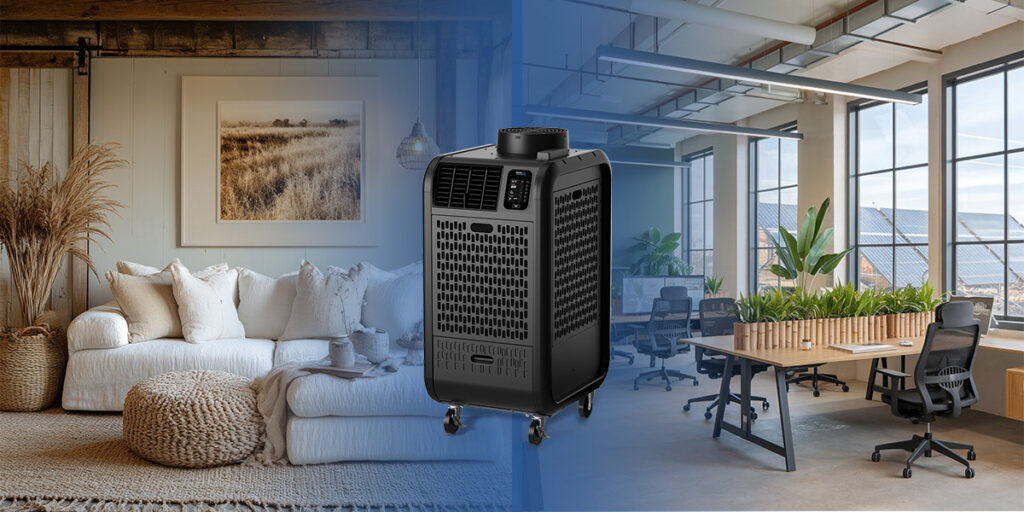
Portable air conditioning units have come a long way in design and capability. Brands like MovinCool are leading the way with product lines tailored to different use-cases. But what makes commercial portable AC units distinct from residential portable ACs? If you’re trying to choose the right system, whether for an office, event space, warehouse, or your home, these are the differences that matter.
What qualifies as “commercial” vs “residential”
- Residential unit: Designed for homes or smaller spaces, bedrooms, living rooms, small lofts. Usually lower capacity (in BTUs or tons), single voltage, simpler controls, fewer rugged features.
- Commercial unit: Built for tougher demands, factories, server rooms, schools, events, workplaces. Higher cooling capacities, more durable components, more flexibility in power, often heavier duty/industrial grade.
Key Differences between Commercial and Residential portable AC units
Here are the most important factors that separate commercial-grade and residential portable ACs:
Feature | Residential Portable AC | Commercial Portable AC |
Cooling Capacity & Coverage | Typically suitable for single rooms or moderate open spaces, enough to cool e.g. 300–800 sq ft depending on insulation, sun exposure etc. | Much higher capacity. MovinCool’s Climate Pro K Series handles larger commercial/office spaces; Climate Pro X Series is intended for industrial and warehouse applications. |
Duty Cycle & Continuous Use | Used intermittently, often on part-time operation (night, day usage with breaks). Not designed for continuous 24/7 heavy load. | Engineered for long operating periods. Might run many hours per day under heavy load. Designed for demanding environments. MovinCool units are built with commercial / industrial applications in mind. |
Power & Voltage Requirements | Usually standard domestic voltage (e.g. 110-120V or 220-240V depending on country), single phase. | May require higher voltage, three-phase power, or specific power configurations. Also, commercial units may have higher amperage draw, may require special wiring or power infrastructure. |
Durability & Build Quality | Lower weight, lighter materials, fewer features for ruggedness. May lack things like heavy-duty compressors, industrial fans, or protective skins. | Stronger frame, robust internal components, better cooling mechanisms, better airflow, protection against outdoor conditions, moisture, heat stress. In MovinCool’s case, series like X and K are purpose-built for industrial or office use. |
Controls, Features & Customization | Basic thermostat, perhaps a timer, simple filters. Designed for ease of use with minimal setup. | More advanced controls, sometimes IoT/connectivity features, more filters, programmable settings, options for ducting or spot-cooling. MovinCool offers units that are connectivity-ready for wireless IoT systems. |
Maintenance & Support | Less frequent, less intensive maintenance. Filter changes, basic cleaning. | More frequent maintenance expected, filter cleaning/replacement, possibly more complex components like condensers, fans, cooling lines. Also, commercial units may have more exhaustive service options and warranty considerations. MovinCool has dealers & support for various industries. |
Cost (Initial & Operating) | Lower upfront cost, lower operational cost under light load. | Higher upfront purchase price, higher energy consumption, possibly additional installation costs (power, ducting, site preparation). But equals greater capacity and reliability in demanding settings. |
MovinCool’s Approach: Where Commercial Units Shine
If you compare MovinCool’s product lines, you can see exactly how they map to commercial demands:
- Climate Pro K Series – built especially for commercial spaces like offices and computer rooms where consistent comfort is essential. These units are more powerful, more rugged, and designed to run smoothly.
- Climate Pro X Series – designed for industrial, warehouse, and other tough environments. These are for “spot-cooling” large spaces, handling high heat loads, production machinery, or hot zones.
- Additional features- MovinCool units are described as connectivity-ready (IoT enabled), which makes monitoring, scheduling, and remote operation easier—an advantage in commercial settings.
Considerations for Choosing the Right Type
If you’re deciding between commercial and residential portable AC, here are a few practical questions to help you choose:
- What is the size of the space, and how much heat load is expected? (Sunlight, machines, electronics, occupancy)
- How many hours per day will the AC need to run? If it’s near continuous, lean commercial.
- What power supply is available? Will you need special wiring or voltages?
- What environmental conditions? Dust, humidity, temperature extremes, commercial units are better built to handle more.
- What is your budget, both initial and ongoing?
- Future flexibility: If you expect growth or increased heat load (e.g. adding equipment, more people), getting a commercial unit might be more “future-proof.”
When Residential Portable AC May Suffice
Even though commercial units have advantages, a residential portable AC might be perfectly fine when:
- Cooling needs are modest (single rooms, occasional use, not high-heat equipment).
- Budget is limited.
- You don’t need rugged durability or continuous use.
- Simpler installation and less concern about power infrastructure.
Why Choosing Commercial for Certain Applications Is Worth It
While more expensive, commercial portable ACs like those from MovinCool deliver:
- Reliable performance in demanding environments (factory floors, server rooms).
- Better energy efficiency per BTU under load.
- Quieter operation when designed properly (since commercial units often have better airflow design).
- Lower downtime and maintenance cost relative to the usage.
The decision between commercial and residential portable AC units isn’t just about cost, but about matching capacity, durability, and design to your actual needs. MovinCool’s product lines, Climate Pro K, Climate Pro X, offer very strong examples of what commercial portable AC units should deliver.
If your cooling needs are modest, a residential unit might do the job fine. But for long hours, large spaces, demanding conditions, or business use, investing in a commercial system will likely save you in performance, energy bills, and hassle.