
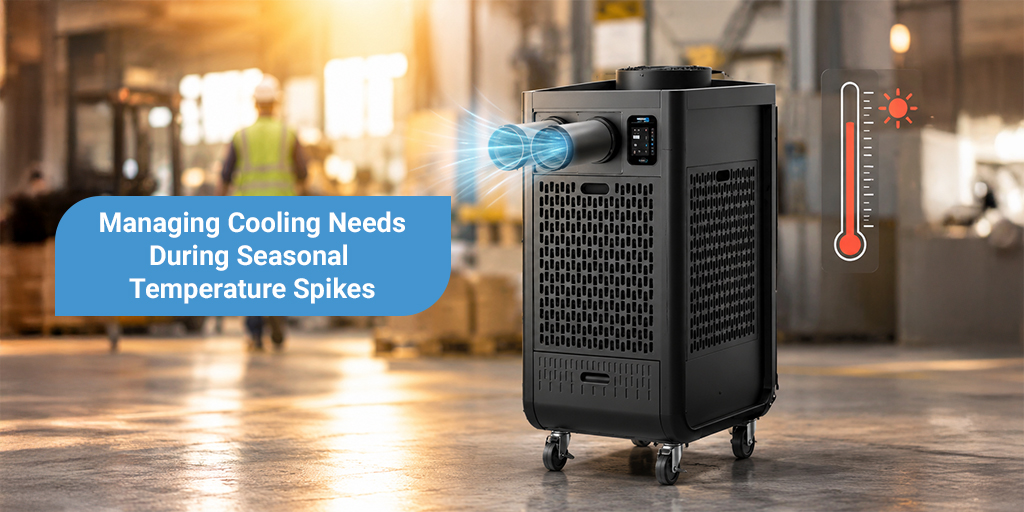
Seasonal temperature changes can create unexpected cooling challenges for businesses, commercial facilities, and industrial operations. As outdoor temperatures rise, heat loads inside buildings can increase, equipment may generate additional heat, and existing HVAC systems may struggle to maintain comfortable or stable operating conditions.
For many organizations, these challenges are not limited to the hottest days of summer. Sudden temperature spikes can occur during transitional seasons, while temporary heat loads and localized cooling requirements can arise at any time of year.
Having a flexible cooling strategy can help businesses respond to changing conditions without relying solely on permanent HVAC systems.
Why Seasonal Temperature Spikes Create Cooling Challenges
Commercial and industrial buildings are designed to handle typical operating conditions, but sudden changes in temperature can place additional demands on existing cooling systems.
Several factors can contribute to increased cooling requirements, including:
- Higher outdoor temperatures and humidity
- Increased occupancy during busy periods
- Additional heat generated by machinery or electronic equipment
- Changes in production schedules
- Temporary workspaces or expanded facility areas
- Aging or overloaded HVAC systems
- Heat entering through windows, doors, and building envelopes
In some cases, a central HVAC system may provide adequate cooling for most of a building while certain areas continue to experience excessive heat.
These localized hot spots can affect employee comfort, equipment performance, and operational efficiency.
Fixed HVAC Systems May Not Address Every Cooling Requirement
Central air conditioning systems are essential for many commercial buildings, but they are not always designed to address every localized or temporary cooling need.
For example, a facility may experience higher temperatures in a server room, production area, warehouse section, or office with large windows. Upgrading an entire HVAC system to address one specific area may not always be practical or necessary.
Portable air conditioning provides another option for these situations.
MovinCool portable cooling solutions are designed to provide targeted cooling for commercial, industrial, and specialized applications. Depending on the model and application, portable units can supplement existing HVAC systems or provide temporary cooling where additional capacity is needed.
Preparing for Seasonal Heat Before It Becomes a Problem
One of the most effective ways to manage seasonal temperature changes is to prepare before cooling problems occur.
Facility managers should consider identifying areas that have historically experienced excessive heat during warmer months or periods of increased activity.
This may include:
- Computer and telecommunications rooms
- Production and assembly areas
- Warehouses and distribution spaces
- Offices with concentrated occupancy
- Classrooms and temporary learning spaces
- Areas containing heat-generating equipment
Understanding where temperature problems are most likely to occur can help businesses determine whether supplemental or portable cooling may be appropriate.
Planning ahead can also help reduce the need for rushed equipment decisions during periods of extreme heat.
Spot Cooling for Localized Heat Loads
Portable spot cooling can be particularly useful when cooling requirements are concentrated in specific areas.
Rather than cooling an entire building, a portable air conditioner can direct conditioned air toward a workstation, production process, piece of equipment, or occupied space that requires additional temperature control.
MovinCool offers several product families designed for different commercial and industrial applications.
The Climate Pro K Series is made especially for commercial spaces where comfort is important to productivity, including offices, schools, hospitals, laboratories, and computer and telecom rooms.
For commercial and industrial environments, including warehouses, factories, assembly lines, and production processes, the Climate Pro X Series provides advanced spot-cooling capabilities.
Selecting equipment based on the specific application can help ensure that cooling is directed where it is needed most.
Seasonal Cooling for Industrial Operations
Industrial facilities often face additional challenges during temperature spikes.
Manufacturing equipment, machinery, lighting, and production processes can all contribute to increased heat inside a facility. When outdoor temperatures rise at the same time, existing cooling systems may face additional demand.
In some environments, excessive heat can affect working conditions or create challenges for temperature-sensitive equipment.
Portable cooling can provide supplemental capacity in areas where additional cooling is needed without requiring permanent changes to the building’s HVAC infrastructure.
The Climate Pro X Series is designed for commercial and industrial spot-cooling applications, including factories, warehouses, manufacturing facilities, assembly lines, and production processes.
This type of targeted approach allows facility managers to respond to localized cooling requirements as conditions change.
Managing Temporary and Unexpected Cooling Requirements
Not every cooling requirement is permanent.
Businesses may experience temporary heat loads during:
- Equipment installation
- HVAC repairs or maintenance
- Seasonal production increases
- Facility renovations
- Temporary workspace expansion
- Unexpected equipment changes
In these situations, portable air conditioning can provide flexibility.
Because portable units can be positioned where additional cooling is required, they can be useful when businesses need a temporary solution without committing to a permanent HVAC modification.
Portable cooling may also serve as supplemental or emergency cooling when existing systems cannot provide sufficient capacity.
Choosing the Right Portable Cooling Equipment
When preparing for seasonal temperature changes, selecting the appropriate equipment is important.
Consider the following factors:
Cooling Capacity
Evaluate the size of the area and the amount of heat generated by people, equipment, and processes.
Application
Determine whether the unit will be used for employee comfort, equipment cooling, production processes, or another specialized purpose.
Electrical Requirements
Review the electrical requirements of the equipment and confirm that the intended location can support the unit.
Portability
Consider how often the unit may need to be relocated and whether mobility is important to your operation.
Operating Environment
Different environments may require different types of portable cooling equipment. Industrial facilities, offices, classrooms, and technology spaces may have different cooling needs.
MovinCool’s portable air conditioning solutions include equipment designed for a variety of commercial and industrial applications.
A Flexible Approach to Seasonal Cooling
Seasonal temperature spikes can be difficult to predict, but businesses can take steps to prepare for changing cooling requirements.
Identifying potential hot spots, evaluating existing HVAC capacity, and considering supplemental cooling options can help facilities respond more effectively when temperatures rise.
Portable air conditioning can provide a practical and flexible way to address localized heat without requiring a complete HVAC upgrade.
Prepare for Changing Cooling Demands
The need for additional cooling does not always follow a predictable schedule. A sudden temperature increase, equipment change, or seasonal shift can create new cooling challenges for commercial and industrial facilities.
Having access to flexible cooling equipment can help businesses manage these situations more effectively.
MovinCool offers portable cooling solutions designed for offices, schools, industrial facilities, warehouses, production environments, and other specialized applications.
Explore the Climate Pro Series to learn more about portable cooling options and find a solution suited to your facility’s specific requirements.
Planning for seasonal temperature changes today can help businesses maintain comfortable environments, support equipment performance, and respond more confidently to changing cooling demands.